A year ago, most boardroom conversations about AI focused on copilots.
Personal productivity.
Writing emails faster.
Summarising documents more efficiently.
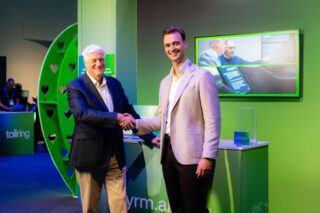
At the Hg Silicon Valley Leadership Summit 2026, however, a different reality emerged.
The industry has crossed an invisible threshold.
The conversation is no longer about AI assistance.
It's about entirely new operating models in which AI agents become the core mechanism through which work gets done.
And perhaps the most important insight from the summit wasn't technical. It was strategic:
The gap between early movers and everyone else is widening faster than almost anyone expected.
Organisations that move decisively over the next 12 to 18 months will compound advantage.
Those that hesitate will find themselves competing against businesses operating at an entirely different speed.
This isn't futurism.
The summit showcased real-world examples:
- Engineering teams producing 3x more output with 20% fewer people.
- Organisations resolving 70% of support tickets through AI.
- Companies launching entirely new product lines that now generate half of their revenue.
The question is no longer:
"Should we do something with AI?"
The question is:
Will we redesign our organisation for an agentic world—or continue optimising for a world that no longer exists?
1. Agentic AI is no longer optional
The summit made one thing abundantly clear:
The transition from AI-assisted to AI-agentic is no longer theoretical.
Today's models can already complete multi-hour tasks autonomously with increasing reliability. The trajectory points toward autonomous multi-day workflows in the near future.
But the real shift isn't technological.
It's organisational.
Frontier engineers are no longer writing code with AI assistance.
They are orchestrating teams of agents.
Multiple agents.
Working in parallel.
Each responsible for a specific feature, task or problem.
The role of the human shifts from execution to orchestration: defining problems, evaluating outcomes, making strategic decisions and maintaining direction.
This creates an effect every executive should understand:
Productivity becomes exponential when the operating model changes.
An engineer supported by eight agents isn't simply eight times faster.
They can explore more possibilities, iterate more quickly and make decisions faster.
The entire competitive landscape changes.
One of the summit's recurring themes was that many organisations continue to treat AI as an optimisation layer on top of existing processes.
That approach generates incremental gains.
But it leaves transformational value on the table.
And it creates opportunities for competitors who are willing to rebuild from first principles.
Another message was equally clear:
Traditional planning cycles are becoming obsolete.
If your organisation still thinks primarily in annual roadmaps, you're already behind.
As one speaker put it:
"Today's models are the least capable models we will ever use again."
Winning organisations think in weeks and months.
Not quarters and years.
2. Become agent-ready: the bottleneck always moves
One of the most practical lessons from the summit was this:
Acceleration without preparation simply creates new problems faster.
Whenever agents accelerate part of a workflow, the bottleneck shifts elsewhere.
The constraint moves.
This is why the largest gains come not from automating isolated tasks, but from redesigning end-to-end processes.
Software development provides a clear example.
Generating code is no longer the bottleneck.
Human understanding is.
When agents can produce thousands of lines of code within hours, review, validation and architectural oversight become the scarce resources.
This introduces a new risk:
Comprehension debt.
Software that works—but that nobody truly understands.
Systems become fragile.
Debugging becomes harder.
Security vulnerabilities become easier to miss.
The same pattern appears everywhere.
In go-to-market teams, AI can generate limitless content and outreach. The constraint becomes strategy, judgement and organisational alignment.
In operations, automation accelerates transactions, while compliance, exception handling and verification become the bottlenecks.
In customer support, AI resolves tickets at scale, but governance and quality control determine whether trust increases or erodes.
The summit highlighted the emergence of an entirely new discipline:
Go-to-Market Engineering.
Not marketing in the traditional sense.
Operational teams working like engineers.
Testing hypotheses.
Running experiments.
Compounding learnings.
Generating Quarterly Business Reviews in minutes.
Monitoring market sentiment in real time.
Executing personalised outreach at scale.
Not because it's possible.
Because competitive pressure increasingly demands it.
The recurring recommendation was simple:
Process first.
Fix workflows before layering technology on top.
Map the entire system.
Otherwise, all you accelerate is noise.
3. Talent and culture become the multiplier
One of the summit's most counterintuitive conclusions was that AI does not make talent less important.
It makes talent dramatically more important.
AI raises the floor.
Average performers become more capable.
But it raises the ceiling even faster.
Top performers become extraordinarily powerful.
The gap between exceptional talent and everyone else expands.
This has major implications for leadership.
Your best people become more valuable than ever.
Investment in development and retention generates compounded returns.
And some employees will struggle with the transition—not because they lack intelligence, but because they lack curiosity and adaptability.
The summit also highlighted where resistance often emerges.
Not from leadership.
Not from frontline employees.
But from middle layers of management, where influence has historically scaled through headcount.
In those environments, efficiency can feel threatening.
The message to leaders was direct:
Lead from the front.
Be willing to be a beginner.
Learn publicly.
Create safety for experimentation and failure.
In an agentic transformation, the largest barrier is rarely technology.
It is culture.
4. Innovation requires a new operating model
Annual roadmaps.
Months of scoping before development begins.
Lengthy design cycles before validation.
These approaches made sense when engineering capacity was scarce.
When agents can build prototypes within hours, they become inefficient—and potentially dangerous.
The new model is built around:
- Rapid prototyping
- Immediate customer validation
- Fast experimentation
- Aggressive prioritisation
- Outcome-driven execution
The summit also warned against what many organisations are becoming:
Feature factories.
Companies that ship hundreds of AI-powered features only to discover that nobody uses them.
Building has never been cheaper.
Building what matters has never required more judgement.
Leadership evolves accordingly.
Less command-and-control.
More vision-setting.
More guardrails.
More obstacle removal.
Smaller teams.
Greater autonomy.
Closer proximity to customers.
What this means for SMEs and public organisations
Most organisations recognise the urgency.
Many struggle with the same challenge:
Alignment.
Agents are not tools.
Agents are a new operating system for work.
And as soon as organisations deploy them seriously, complexity increases:
- More data flows
- More integrations
- More governance requirements
- More operational risk
- More need for orchestration
This is why the market is becoming increasingly polarised.
Early movers are building systems.
Everyone else is collecting tools.
Where Fyrm.ai comes in: Orchestrated Intelligence
At Fyrm.ai, we build Agentic Enterprise Systems: orchestrated networks of AI agents that think, decide and act within the processes and infrastructure organisations already rely on.
Our philosophy is simple.
MCP is the universal adapter
Our Master Control Protocol connects existing ERP systems, CRM platforms, databases, cloud environments and APIs without requiring expensive transformation programmes.
No rip-and-replace initiatives.
We work with what already exists and make it work together.
Technology independence
We are not tied to a specific model, vendor or cloud platform.
Whether the best solution is OpenAI, Anthropic, Google Gemini, Meta Llama or another emerging technology, we select the tools that fit your organisation's context.
Orchestration is everything
Disconnected agents create chaos.
That's why every deployment includes a central orchestrator agent that coordinates tasks, allocates responsibilities, enforces guardrails and ensures people, systems and processes work as one.
Human-in-the-loop, always
Agents take over repetitive and time-consuming work.
Humans retain judgement, accountability and oversight.
AI amplifies professionals.
It does not replace them.
Particularly in SMEs and public-sector organisations, trust, governance and transparency remain non-negotiable.
In short:
Not AI as an add-on.
But an operating system that makes your organisation truly agent-ready.
Start with a Fyrm.ai Audit
The summit's message was clear:
The window is open.
But it will not stay open forever.
Organisations that create clarity today will build sustainable advantage tomorrow.
That is why many organisations start with a Fyrm.ai Audit rather than another pilot project.
Together, we assess:
- Where AI and agents can create the greatest business impact
- Which processes and data foundations need attention first
- Which governance, security and privacy risks must be addressed
- What the most realistic path to production looks like
If you're ready to understand where your organisation stands today—and how to move forward with confidence—we invite you to start with a Fyrm.ai Audit.
Fyrm.ai
Orchestrated Intelligence.